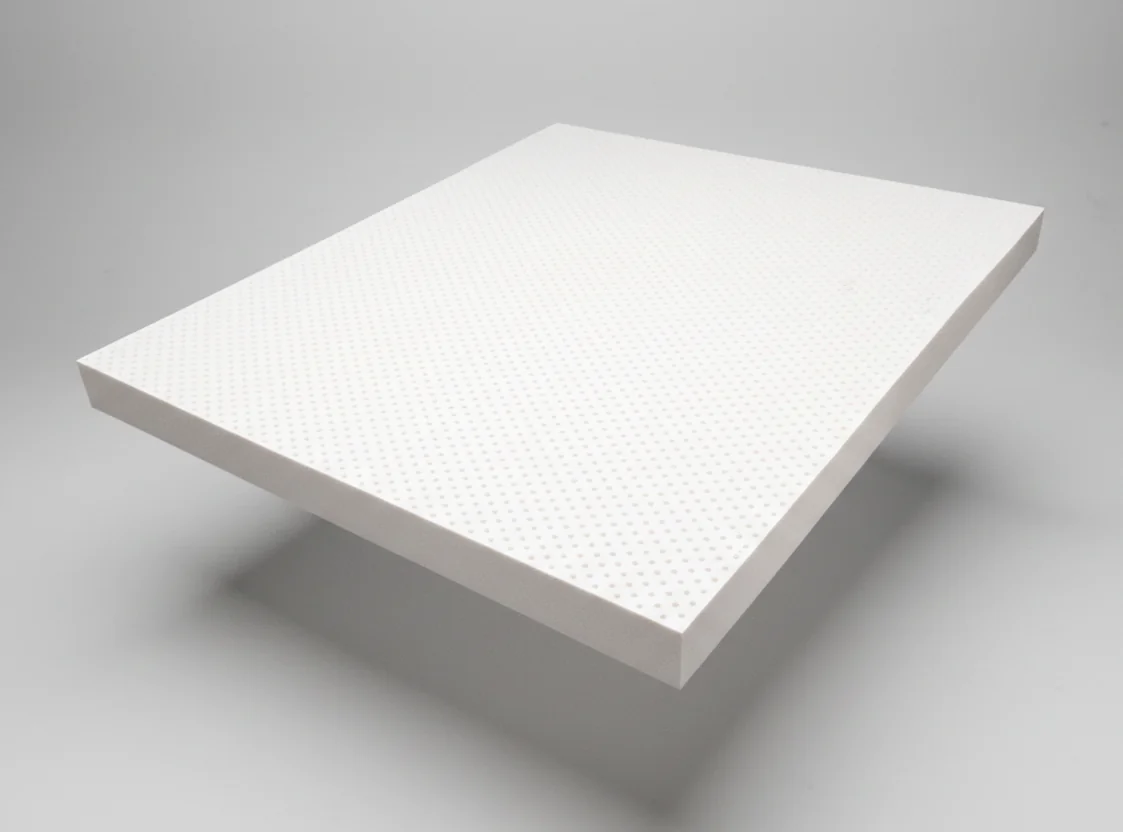
Buyers sourcing latex components often see two process names on spec sheets: Dunlop and Talalay. Both start from the same raw material, natural latex, but the manufacturing process changes the density, feel, and typical application of the finished foam. Understanding the difference helps you specify the right material for a support core, a comfort layer, or a topper, rather than guessing.
How Dunlop Latex Is Made
In the Dunlop process, foamed liquid latex is poured directly into a mold in a single pass. The filled mold is then cured, typically through a baking or vulcanization step that sets the foam structure, before the finished block or sheet is removed, washed, and dried. Because the mold is filled completely and cured as one mass, Dunlop latex tends to settle slightly during curing, which can produce a marginally denser base layer within a single piece. The result is a foam that is generally firmer and denser overall, with a consistent, springy response to pressure.
How Talalay Latex Is Made
Talalay latex starts the same way, with foamed liquid latex poured into a mold, but the process adds several extra steps. The mold is only partially filled, then mechanically vacuum-expanded so the foam fills the entire cavity evenly. The mold is then flash-frozen to lock the cell structure in place before the latex is cured. This extra expansion and freezing stage is what gives Talalay latex its lighter, more uniform cell structure from top to bottom, and its characteristically softer feel.
Comparing the Two
Density and firmness: Dunlop latex is generally denser and firmer, which is why it is the more common choice for support cores and firmer toppers. Talalay latex is typically lighter and softer, which suits plush comfort layers and pillows where a gentler initial feel is the goal. These are general tendencies rather than fixed rules, since firmness within either process still varies by formulation and target ILD.
Consistency: Talalay’s vacuum-expansion step produces a very even cell structure throughout the piece. Dunlop can show a small amount of natural density variation across a thicker piece, a byproduct of the simpler pour-and-cure method, though this has little practical effect on how the foam performs in a finished mattress or cushion.
Production cost: The Dunlop process involves fewer steps and less specialized equipment, which generally makes it more efficient to produce. Talalay’s additional vacuum and freezing stages add time, energy, and equipment cost to each production run, which is typically reflected in a higher price for finished Talalay components.
Responsiveness: Both types of latex are known for a springy, buoyant feel compared to other foam materials. Dunlop tends to return to shape briskly under load, while Talalay is often described as having a slightly bouncier quality. Neither behavior is objectively better; it comes down to the feel a manufacturer wants in the finished product.
Which One Should You Build With?
There is no single correct answer, since Dunlop and Talalay are suited to different roles in a product build. Many multi-layer mattress and cushion constructions actually use both: a denser Dunlop layer for support, paired with a softer top layer for comfort. If your product needs a dependable support core, a firmer topper, or a material that performs consistently at scale, Dunlop is generally the more practical and cost-efficient choice. If your product calls for an especially soft, plush top layer or a light pillow fill, Talalay’s process may suit that specific application well.
It is also worth remembering that the process name alone does not guarantee a specific firmness. Two Dunlop pieces from different suppliers, or two Talalay pieces for that matter, can still land at different points on the firmness scale depending on formulation and target specification. When you are comparing quotes, ask for the actual ILD and density figures rather than relying on the process name by itself, so you know exactly what you are ordering.
Our Position
We supply Dunlop natural latex exclusively, sourced from established manufacturing partners, across mattress cores, toppers, layers and sheets, blocks, and pillows, in every ILD and thickness a build requires. Focusing on one process means every order ships to the same consistent specification, batch after batch, which makes it easier for you to plan production and keep your finished product performing the same way over time. We are not the right source if your build specifically calls for Talalay, but for buyers who want a dependable, well-supported natural latex core or comfort material, Dunlop is a proven choice worth evaluating.
See and feel the difference for yourself. Request a Free Sample of our Dunlop natural latex before you finalize your next build.