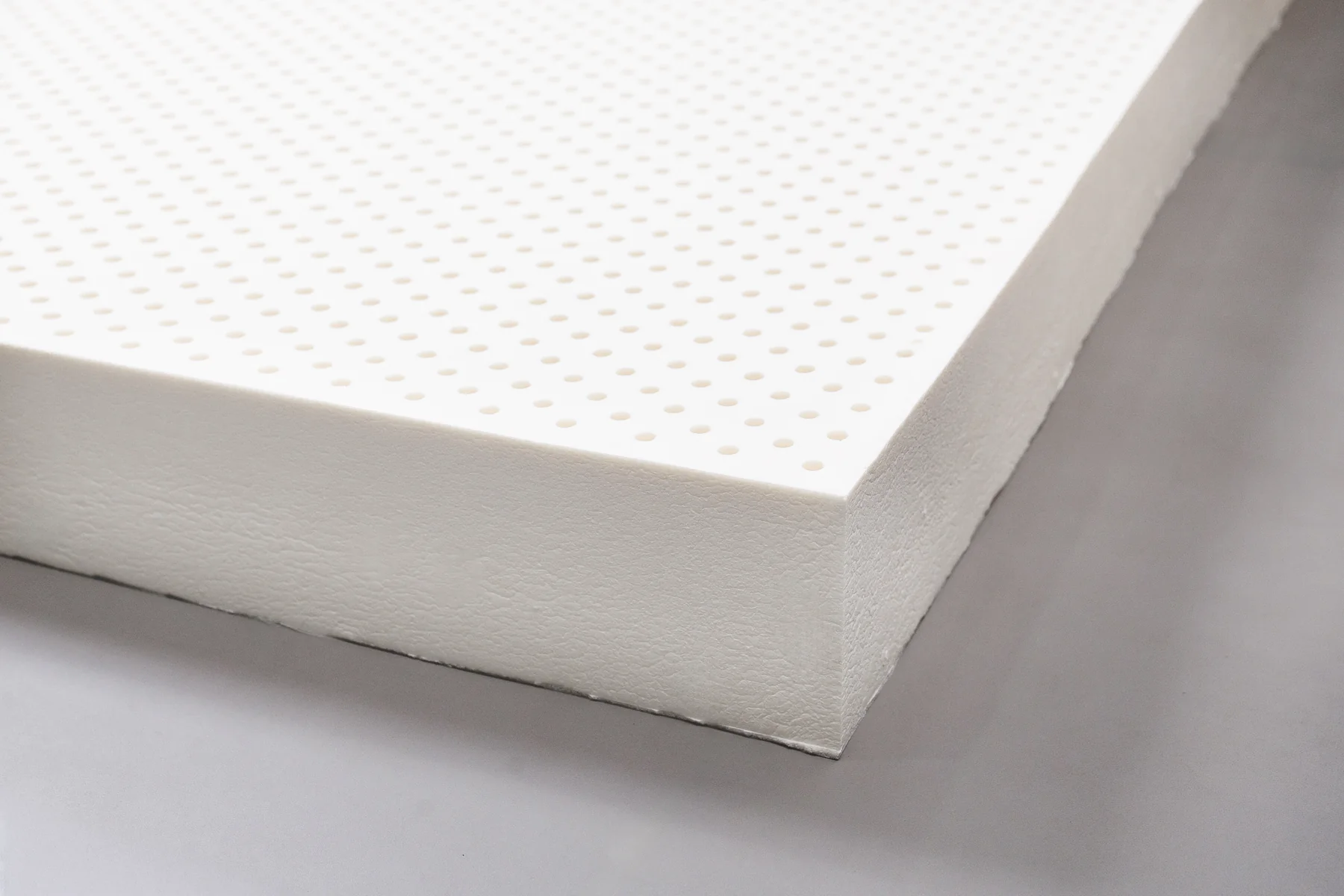
Latex and memory foam are the two materials manufacturers most often weigh against each other when building a mattress or topper line. Both are used as comfort and support layers, and both have loyal followings among end customers, but they come from different origins and behave very differently once they are inside a finished product. Here is a practical comparison for anyone specifying materials for a new build.
Where Each Material Comes From
Natural latex is derived from the sap of the rubber tree, foamed and cured, most commonly through the Dunlop process, into blocks, sheets, cores, toppers, and pillows. Memory foam, by contrast, is a polyurethane foam, a synthetic material built from petroleum-based chemical inputs and engineered specifically for its slow-recovery, viscoelastic behavior. The two materials are manufactured through entirely different processes and are not variations of the same foam family.
How They Feel and Respond
This is where the two materials diverge most clearly. Latex has a buoyant, springy response: it compresses under pressure and pushes back almost immediately, distributing weight across the surface rather than sinking deeply in one spot. Memory foam behaves in the opposite way. Its viscoelastic structure is designed to soften with body heat and slowly conform around pressure points, then recover its shape gradually once weight is removed. Neither response is better in an absolute sense, they simply produce a different feel, and end customers tend to have a strong preference for one over the other once they have tried both.
For a manufacturer, this difference matters beyond marketing. A latex layer and a memory foam layer of the same thickness will not perform the same job in a construction. Latex is often used as both a support and comfort material on its own, while memory foam is typically layered over a firmer support base, since memory foam alone tends to lack the structural support needed for a full mattress core.
Manufacturing and Handling Differences
Latex arrives from the supplier as a finished, cured foam, ready to be cut, laminated, or built into a mattress or cushion construction. It holds a consistent shape at room temperature regardless of ambient warmth. Memory foam’s viscoelastic property means its feel changes somewhat with temperature, becoming softer in warmer conditions and firmer when cool, which is a design feature of the material rather than a defect, but it is a variable manufacturers need to account for in testing and quality control.
Airflow is another practical difference worth noting for construction planning. Natural latex, particularly when produced with the pinhole pattern common in cored and topper products, has an open structure that allows air to move through the material more readily than a dense, closed viscoelastic foam. This can be a relevant factor in how a finished mattress or topper is engineered and marketed, independent of any comfort claims.
Durability Considerations
Latex’s cellular structure is generally recognized in the foam industry for resisting compression set, meaning it tends to hold its original shape well under repeated, sustained pressure over years of regular use. Standard memory foam can be more prone to gradual softening or body impressions over time, particularly at lower densities. Higher-density memory foam formulations narrow this gap, but density also affects cost, so manufacturers balancing budget against long-term shape retention should factor this into their sourcing decisions.
Building With Both
Many manufacturers do not treat this as an either-or decision. Hybrid constructions that pair a natural latex layer with a memory foam layer are common, combining latex’s support and responsiveness with memory foam’s contouring feel in a single product. If you are exploring this kind of build, the latex layer’s thickness, ILD, and placement in the stack all affect how the finished mattress performs, and are worth specifying carefully alongside your memory foam supplier’s data sheet.
Where We Fit In
We supply Dunlop natural latex components, cores, toppers, layers and sheets, blocks, and pillows, in every ILD and thickness a build calls for, whether you are building an all-latex product or a hybrid construction alongside memory foam. Our team can work from your target specification to help you source the right latex layer for your build.
Want to compare latex against what you are currently using? Request a Free Sample and test our natural latex in your own product development process.