Once natural latex sap has been collected from rubber trees, it still has to become the foam that buyers actually specify by ILD, thickness, and size. That transformation happens through curing, and we supply our latex, produced using the Dunlop process exclusively by established manufacturing partners.
How Dunlop Latex Is Made
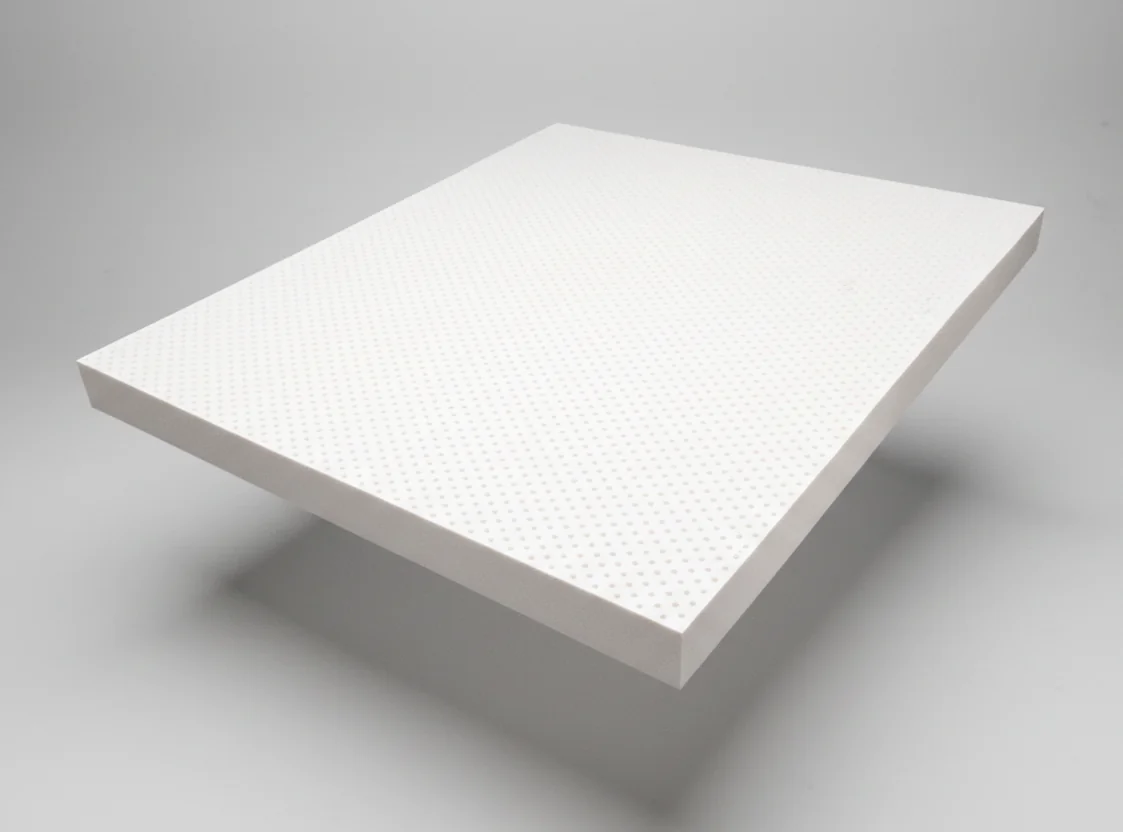
The Dunlop method is one of the two main ways natural latex sap is turned into foam, the other being Talalay. In the Dunlop process, compounded liquid latex is foamed and poured directly into a mold in a single pass. Metal pins running through the mold create the familiar pattern of pinholes, which help the foam cure evenly and later allow air to move through the finished material.
The filled mold is cured, typically through a baking or vulcanization step that sets the foam’s structure. Because the mold is filled completely and cured as one mass, the process settles slightly during curing, producing foam that is generally firmer and denser than foam made through the Talalay method. Once cured, the block or sheet is removed from the mold, washed, and dried before it moves on to cutting and finishing.
What This Process Produces
The result is a dense, resilient natural latex foam with a consistent, springy response to pressure. Dunlop latex tends to hold its shape well under sustained load, which is part of why it is a common choice for support cores and firmer toppers in mattress and cushion construction. The open cell structure created by the pinhole pattern also allows air to move through the material, which is a relevant factor in how a finished product is engineered.
Because the Dunlop process involves fewer steps than the alternative Talalay method, it is also generally more efficient to produce, which is often reflected in the cost of the finished foam.
Consistency, Order After Order
For a buyer specifying components for a product line, consistency matters as much as the initial feel of a sample. Because we work in Dunlop natural latex exclusively, rather than switching between different processes and formulations, every order we supply is produced to the same process and the same target specification. A mattress core, topper, or block ordered today is made the same way as one ordered next year, which makes it easier to plan a product line and know what you are getting batch after batch.
From Foam to Finished Component
Once the foam has been cured, washed, and dried, it is still a block or sheet, not yet the mattress core, topper, layer, or pillow a buyer actually orders. That final step, cutting and finishing the cured foam into specific products, is where the material becomes something ready to ship.
If you want to feel the difference Dunlop processing makes for yourself, a sample is the most direct way to judge it.